For the first time since the Living Wage & Income Lab began, 2025 was the year we truly closed the loop. We hosted deep-dive sessions in producer countries—and then brought producer organisations to the Netherlands to speak directly with buyers shaping their income realities.
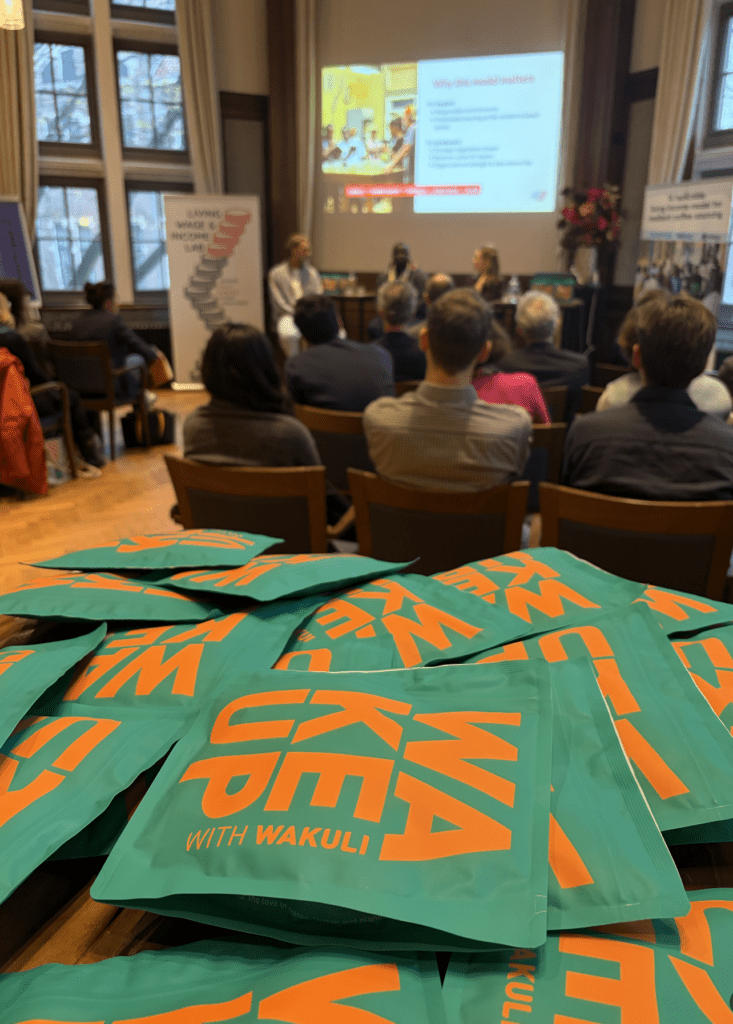
The final Lab session of the year, held on November 27th, made one thing clear: the future of responsible sourcing cannot be designed without the first mile in the room.
The session featured Bless Agume, Director of Operations of Ndugu Coffee Farmers, and Meine van der Graaf, Impact Manager at Wakuli. Ndugu is a social enterprise working with 32 coffee cooperatives and more than 10,000 smallholder farmers in Uganda’s Masaka region. Wakuli, a Dutch coffee roaster, is among the few buyers actively using farmer-level data to guide purchasing decisions aimed at keeping coffee farming viable over the long term. Together with Fairfood, they are co-developing a replicable, producer-led living income model as part of a one-year Due Diligence Fund programme supported by SASI–GIZ.
You can read all about the Fairfood-Ndugu-Wakuli partnership here.
The session was further enriched by the thoughtful questions raised by our colleagues at The Good Spice, represented by Sanne Swinkels. Working towards decent wages for the people behind their flavourful products, she brought insights from a very different supply chain – reminding us that while there is no silver bullet, there are always shared learnings to build on.
Drawing on the real challenges faced by Wakuli, Ndugu, and The Good Spice, this fully booked session invited practitioners to work through the everyday-barriers still preventing well-intentioned companies from delivering living incomes and living wages to the people who make their businesses possible.
From compliance to shared decision-making
Coffee prices continue to swing dramatically—from record highs to sudden drops. For farmers relying on one or two harvests per year, these shifts directly affect whether households can cover school fees, healthcare, or reinvest in their farms.
Meine explained why buyers like Wakuli need better data—and better models. “If you don’t want to use the C-price as your baseline, you need additional information to decide on a fair price. Cost-of-production data, segmented by farm size and practices, becomes essential.”
At the same time, he acknowledged that income is still rarely treated as a core business responsibility—often remaining a sustainability add-on rather than a pricing input.
This tension is exactly where the Lab creates space: moving living income from aspiration to calculation, and from narrative to negotiation.
What changes when producers own the data
For Ndugu, the shift came when data stopped being a reporting requirement and started becoming a decision-making tool. “At first, data was about ticking the box. Now we ask: how does it create real value for farmers?”, Bless Agume explained.
He shared examples of how farmer-level data is already being used:
- Credit scoring that enables access to fertiliser loans
- Carbon credit pilots linked to verified agroforestry practices
- Farmer IDs that could connect producers to clinics or input shops, even outside harvest season
Aggregation, trust, and bargaining power
One message resonated strongly across the room: aggregation changes everything.
A single farmer selling 40 kilos of coffee has little leverage. Aggregating thousands of farmers into reliable volumes changes who sits at the table—and on what terms. “When we aggregate 10,000 farmers, exporters want to talk to us. Buyers want to talk to us.”
But volume alone is not enough. Data makes negotiation credible, and trust determines whether transparency actually works. Bless’s vision of a shared dashboard—where producers and buyers see the same information—sparked discussion, but also highlighted a reality: transparency is relational, not just technical.
Why this Lab format works
What sets the Living Wage & Income Lab apart is not the tools, but the structure:
- producer organisations as experts, not beneficiaries
- buyers as co-designers, not auditors
- data as a shared language, not a control mechanism
By bringing first-mile voices into European rooms—and grounding conversations in real numbers rather than assumptions—the Lab enables a different kind of dialogue.
An invitation for 2026
As we look ahead, the Living Wage & Income Lab is opening up to new collaborators. In 2026, we want to co-host sessions with buyers, producer organisations, cooperatives, NGOs, tech providers, and platforms who are testing practical solutions and want to build on this format.
If you have a case, a challenge, or a question that deserves a room of peers—and the voices of the first mile—let’s build the next edition together.